UID159262
威望5
金钱72915
交易诚信度23
主题48
帖子1243
注册时间2005-6-28
最后登录2018-8-31
高级会员

交易诚信度23
注册时间2005-6-28
|
KUBE or Not KUBE?
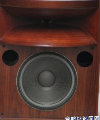
That is the question, and the 107 answers in the affirmative. The KUBE cuts through several vexing problems that have traditionally compromised subwoofer designs. Even my six-year-old, Dahlia, associates bass sensitivity and extension with large enclosures. And, indeed, the laws of physics conspire to make it so, as Richard Small (now working as Head of Research at KEF in the UK) and A.N. Thiele so aptly demonstrated almost 20 years ago. I'll get a bit didactic and elaborate:
In order to achieve flat LF response to, say, 20Hz, you have to start with a woofer whose free-air resonance is no higher than 20Hz, and preferably even a bit lower. Remember that below the driver's resonant frequency, the output will droop as the driver is no longer mass-controlled and cannot maintain a constant acceleration as frequency decreases. Next, it turns out that a large woofer is much more adept at pressurizing a given-size box than a small woofer, and a very large air volume is needed to prevent the air stiffness of the enclosure from significantly raising the system's resonant frequency. Reduce the volume and low bass can still be squeezed out of the design, but only at the expense of severely curtailing sensitivity.
If you want low bass and a usable sensitivity, therefore, what you end up with is a very large box that is not only expensive to construct and ship, but also, most importantly, almost impossible to make rigid enough to minimize colorful cabinet radiations. Have you ever seen the WAMM subwoofer? Do you know how much carpenters get paid these days? Now you know why that system costs over $40k. So it appears that, at least for realistically sized production-line speakers, the hopes of realizing a 20Hz response using a natural alignment are doomed.
The intelligent engineering solution is to use active equalization between the pre- and power amplifiers to "artificially" extend and flatten the LF response. There has been a recent trend to do just that: recall for a moment the Enigma subwoofer, or, more recently, the free-standing Celestion woofer (footnote 1). (Of course, the latter two designs minimize cabinet colorations by doing away with the cabinet altogether, another plus.) KEF's strategy is to align the coupled-cavity for optimum upper-bass sensitivity, then boost the frequencies below the natural turnover to give a flat extended response.
(Don't run out now and buy yourself an equalizer to do just that with your speakers; odds are that you'll simply succeed in destroying the woofers. You should know that woofers are unhappy about being pushed into the deep bass because cone velocity doubles and excursion quadruples for each lower octave. Any design that uses bass boost, therefore, must necessarily include woofers that can cope with the excursion demands.) |
|
 楼主: 蜂皇
 [复制链接]

 京公网安备 11010602010207号
( 京ICP证041102号,京ICP备09075138号-9 )
京公网安备 11010602010207号
( 京ICP证041102号,京ICP备09075138号-9 )













 狗仔卡
狗仔卡
 发表于 2008-8-7 11:06