UID28476
威望48
金钱121864
交易诚信度0
主题16
帖子689
注册时间2003-1-1
最后登录2025-12-31
特级会员

交易诚信度0
注册时间2003-1-1
|
既然大家感兴趣我觉得首先应当还原一下硫磺岛战役的原貌 (中立的记载)
The Battle of Iwo Jima was fought by the United States of America and the Empire of Japan in February and March 1945, during the Pacific Campaign of World War II. The U.S. invasion, known as Operation Detachment, was aimed at capturing the airfields on Iwo Jima. The Japanese soldiers were known as "Japs" to the Americans.
The battle is famous as the origin of a picture of five Marines from the 5th Marine Division, along with a U.S. Navy corpsman, raising the U.S. flag atop the 166 meter (546 ft) Mount Suribachi, the highest point on Iwo Jima,during the battle. The Marines captured Suribachi in the first week offighting. Three of the six flag-raisers were killed before Iwo Jima wassecured.
The Battle of Iwo Jima
Ground fighting on the island took place over approximately 35 days,lasting from the landings of February 19th to a final Japanese chargethe morning of March 26th, 1945.
Initial landings 
Marines landing on Iwo Jima.
At 02:00 on February 19,battleship guns signaled the commencement of D-Day. Soon 100 bombersattacked the island, followed by another volley from the naval guns.Although the bombs were consistent, it didn't deter the Japanese'sdefenses. At 08:59, one minute ahead of schedule, the first of aneventual 30,000 Marines of the 3rd, 4th, and 5th Marine Divisions, under V Amphibious Corps, landed on the Japanese island of Iwo Jima and a battle for the island commenced.
The Marines faced heavy fire from Mount Suribachiat the south of the island, and fought over inhospitable terrain: roughvolcanic ash which allowed neither secure footing nor the digging offoxholes. Nevertheless, by that evening the mountain had beensurrounded and 30,000 Marines had landed. About 40,000 more wouldfollow.
Taking Mt. SuribachiBy the morning of the fourth day of the battle, Mount Suribachi waseffectively cut off from the rest of the island—above ground. By thatpoint, the Marines knew that the Japanese defenders had an extensivenetwork of below-ground defenses, and knew that in spite of itsisolation above ground, the volcano was still connected to Japanesedefenders via the tunnel network. They expected a fierce fight for thesummit.
Two four-man patrols were sent up the volcano to reconnoiter routeson the mountain's north face. Popular legend (embroidered by the pressin the aftermath of the release of the now-famous photo "Raising the Flag on Iwo Jima")has it that the Marines fought tooth and nail all the way up to thesummit. But although the riflemen were tensed for an ambush, nonematerialized. They made it to the summit and scrambled down again,reporting the lack of enemy contact to Colonel Chandler Johnson.
Johnson then called for a platoon of Marines to climb Suribachi.With them, he sent a small American flag to fly if they reached thesummit. Again, Marines began the ascent, expecting to be ambushed atany moment. And again, the Marines reached the top of Suribachi withoutincident. Using a length of pipe they found among the wreckage atop themountain, the Marines hoisted the U.S. flag over Mount Suribachi, thefirst foreign flag to fly on Japanese soil in centuries.
As the flag went up, Secretary of the Navy James Forrestalhad just landed on the beach at the foot of Mt. Suribachi. He decidedthat he wanted the flag as a souvenir. Popular legend has it thatColonel Johnson wanted the flag for himself; in fact, he believed thatthe flag belonged to the 2nd Battalion, 28th Marines, who had capturedthat section of the island. He sent Sergeant Mike Strank (who wasphotographed in the Flag Raising picture) to scrounge up a second flag,and sent that one up the volcano to replace the first. As the firstflag came down, the second went up, and it was then that Associated Press photographer Joe Rosenthal took the famous photograph "Raising the Flag on Iwo Jima" of the replacement flag being planted on the mountain's summit.
After Mt. Suribachi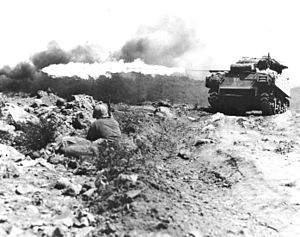
Several M4A3 Sherman tanks equipped with flamethrowers were used to clear Japanese bunkers.
Despite the loss of Mt. Suribachi,the Japanese still held a strong position. Kuribayashi still had theequivalent of eight infantry battalions, a tank regiment, two artilleryand three heavy mortar battalions, plus the 5,000 gunners and navalinfantry. The struggle to take the Motoyama Plateau, including "TurkeyKnob" was to take the better part of three weeks. The Japanese actuallyhad the Marines outgunned in this area, and the extensive tunnelsallowed the Japanese to reappear in areas thought "safe". It was withweapons like the 8 Sherman M4A3 medium tanks equipped with the NavyMark I flame thrower ("Ronson" or Zippo Tanks) that the Marines would force the Japanese to leave their caves.
Close air support was initially provided by fighters from escortcarriers off the coast. This shifted over to the 15th Fighter Group(flying P-51 Mustangs)after they arrived on the island on D+15. Similarly, illuminationrounds (flares) which were used to light up the battlefield at nightwere initially provided by ships, shifting over later to landing forceartillery. Navajo code talkers were a key part of the American ground communications, along with walkie-talkies and SCR-610 backpack radio sets.
Final days of the Battle
"Unloading on the beach of Iwo Jima".
With the landing area secure, more troops and heavy equipment cameashore and the invasion proceeded north to capture the airfields andthe remainder of the island. Most Japanese soldiers fought to thedeath. On the night of 25 March, a 300-man Japanese force launched afinal counterattack in the vicinity of Airfield Number 2. Army pilots, Seabees and Marines of the 5th Pioneer Battalionand 28th Marines fought the Japanese force until morning but sufferedheavy casualties—more than 100 killed and another 200 American wounded.Of all the Japanese that fought, 20,703 were killed and 216 werecaptured.[1] The island was officially declared "secure" the following day.
Aftermath
"Among the men who fought on Iwo Jima, uncommon valor was a common virtue"—Admiral Chester W. Nimitz大家看看这句话体会一下 Of the over 22,000 Japanese soldiers, 20,703 died, and 216 werecaptured. The Allied forces suffered 25,281 casualties, with 5,598deaths. This was the only large engagement of WWII in which the Alliedforces suffered more casualties (dead plus injured) than their Japaneseopponents.
After Iwo Jima was declared secured, the Marines estimated therewere no more than three hundred Japanese left alive in the island'swarren of caves and tunnels. In fact, there were close to threethousand. The Japanese bushidocode of honor, coupled with effective propaganda which portrayedAmerican G.I.'s as ruthless animals, prevented surrender for manyJapanese soldiers. Those who could not bring themselves to commitsuicide hid in the caves during the day and came out at night to prowlfor provisions. Many did eventually surrender, and were surprised thatthe Americans often received them with compassion, offering water,cigarettes, or coffee.[5]The last of these stragglers, two of Lieutenant Toshihiko Ohno's men,Yamakage Kufuku and Matsudo Linsoki, lasted six years, surrendering in1951[6] (another source gives the date of surrender as January 6, 1949[7])
Over a quarter of the Medals of Honorawarded to Marines in World War II were given for conduct in theinvasion of Iwo Jima. The Marines, both active duty and reservists,were commended with 22 Medals of Honor. An additional five Medals ofHonor were bestowed upon five Navy servicemen and reservists. Thistotal of 27 is the most ever given in a single battle to date.
Given this bloody sacrifice, the necessity and long-termsignificance of the island's capture to the outcome of the war was acontentious issue from the beginning, and remains disputed. As early asApril 1945 retired Chief of Naval Operations William V. Pratt asked in Newsweek magazine about the "expenditureof manpower to acquire a small, God-forsaken island, useless to theArmy as a staging base and useless to the Navy as a fleet base ...[one] wonders if the same sort of airbase could not have been reachedby acquiring other strategic localities at lower cost."[8]The Japanese on Iwo Jima had radar with which they notified theircomrades at home of incoming B-29s flying from the Marianas. Fighteraircraft based on Iwo Jima sometimes attacked these planes, which wereespecially vulnerable on their way to Japan because they were heavilyladen with bombs and fuel. The island was also used as an air-searescue base after its seizure. However, the traditional justificationfor Iwo Jima's strategic importance to the United States' war efforthas been that it provided a landing and refueling site for Americanbombers on missions to and from Japan. As early as March 4, 1945, while fighting was still taking place, the B-29 bomber Dinah Might of the USAAF 9th Bomb Groupreported it was low on fuel near the island and requested an emergencylanding. Despite enemy fire, the airplane landed on theAllied-controlled section of the island, without incident, and wasserviced, refueled and departed. In all, 2,251 B-29 Superfortresseslanded on Iwo Jima during the war.
http://file:///C:/DOCUME%7E1/ADMINI%7E1/LOCALS%7E1/Temp/moz-screenshot-1.jpghttp://file:///C:/DOCUME%7E1/ADMINI%7E1/LOCALS%7E1/Temp/moz-screenshot.jpg
[ 本帖最后由 dave9181 于 2007-3-23 09:14 编辑 ] |
|

 楼主: 皇帝的新衣


 京公网安备 11010602010207号
( 京ICP证041102号,京ICP备09075138号-9 )
京公网安备 11010602010207号
( 京ICP证041102号,京ICP备09075138号-9 )




 狗仔卡
狗仔卡
 发表于 2007-3-23 08:57